Thursday, September 19, 2013

The World in the Cold; A Review of The Little Ice Age

 
From 1300-2000, the world had seen many events unfold. Wars that destroyed cultures and new nations being formed. However, one thing people never consider was the weather in this time. Many people don’t see the weather as important, but in fact it was a major contributor to this time period and is best described by Brian Fagan.


Brian Fagan is the author of the book The Little Ice Age, a non fiction book that tells the story of the Little Ice Age; a period in the world where the weather was extremely cold and how it was able to impact society. While the story does show how the weather was a key factor in many historical events, overall it was an average read at best.
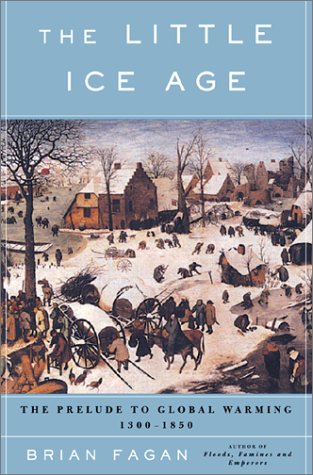
             
The story itself is interesting when you look at it from a historical perspective, but the story just wasn’t able to get my attention. It basically droned on about how the weather was cold and there was starvation and death. Now, not everything in this book was uneventful. The sections on how Vikings settled in Greenland and how new innovations in food came, like the introduction of the potato and putting salt on cod to keep it fresh in the pre “refrigerator” era, were interesting and informative The pictures showing the world and the effect of sea currents also were interesting as it allowed the audience to see how ocean currents impacted the world.

 
The problem with the book was that it just seemed to drone on about different statistics and events in history. It kept relating back to important weather patterns and it also talked about the North Atlantic Oscillation, which itself is interesting, but the way it was presented just made itself boring. Now, this is not an attack against nonfiction altogether. Nonfiction is an interesting genre because it allows readers to experience events that actually happened. However, this book just droned on about different events that happened in history with nothing to grab the readers attention.

 
This is an interesting concept and it could have been an interesting story had it been told in a more interesting way. While the story altogether bores the reader, Brian is able to make great use of the rhetorical triangle. The reader is initially drawn into the story from the summary, which allows Fagan to establish his ethos, or character. The audience learns that he is a historian with a great knowledge on this topic. Fagan is also able to establish logos, or logic, almost every chapter, backing up all of the claims he made with hard proof. The only area where he would have to struggle is in pathos, or emotion. He draws on little sympathy from the reader when depicting the amount of death during the Black Plague, but as this is just a recap of 700 years, he is unable to fully develop pathos from the reader, effectively losing the reader's attention.

Overall, the book rates out to be average at best. The information presented in here is credible and it doesn’t seem to contain any fallacies. However, the way its presented causes the reader to wonder if they’re just reading the same concept over and over again. He could have tried and described the citizens freezing from the cold or go more in depth on the volcano that erupted and how its ash affected the ozone. The attention span of a reader is generally weak. In order to fully grab someone’s attention, a writer needs to not only create a good hook, but also to entertain the reader so that they won’t get bored halfway through the book and give up on it completely.
 
 While Fagan’s book isn’t the most eventful read, the way he presented his information was incredible and it allows the audience to view an unknown phenomenon caused the world’s society to shape into what it is today. This topic may interest some readers who have an interest in history or science. However, the endless drone about death and starvation causes this book to be an unpopular read.

 

Tuesday, September 17, 2013

Fallacies in The Big Bang Theory (CC)

Since we have been studying fallacies and what affect they have in writing, I thought it would be interesting to look at fallacies in one of my favorite TV shows, The Big Bang Theory. To start, a fallacy is an argument that uses poor reasoning, with many fallacies ending up being false. Heading back to The Big Bang Theory the show mainly revolves around the antics of Sheldon Cooper and his friends, I noticed that there are a few fallacies in this sitcom. One was in an episode where Sheldon and his friends return home after living in the Arctic for three months. Sheldon's very religious mother believed that it was the prayers from her church group that brought him back safe. this demonstrates a false cause fallacy, as she believed that the prayers brought him back. Another fallacy that is used a lot in the Big Bang Theory is reductio ad absurdum. It may be unknown to a lot of people, but it is where someone uses another persons argument and extended it to extreme proportions in order to insult the person. This is used a lot against Sheldon by his friends, as he tends to overthink every single detail.


As demonstrated, Reductio ad Absurdum can be useful in the right situations. Basically, its like using sarcasm against someone or something, exaggerating stuff to insult it. This type of fallacy is used a lot in TV shows mainly to blow things out of proportion and give the audience a good laugh.

Fallacies are a very interesting device in writing. When I was initially introduced to this concept, it didn't make a whole lot of sense and it left me confused. However, once we began to look closely at different types of fallacies, I finally understood its meaning and I enjoy them very much. I really look forward to exploring them more in English.

Tuesday, September 10, 2013

Wow. A post about Sarcasm (Rhetorical Device)

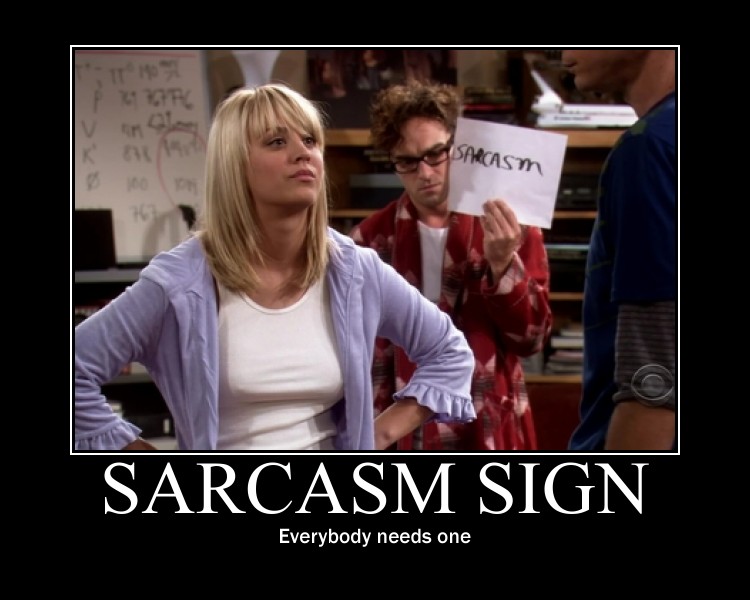
I decided to post about sarcasm mainly because it is used a lot in my family and it is an interesting way to grab attention from the reader. Sarcasm is a type of irony where someone who is praising something is in fact criticizing it. An example is when someone in my family says something really obvious, my dad usually responds with "Nothing gets by you." Sarcasm is a fun device because when it is used, it usually brings enjoyment to the reader and allows the reader to become comfortable with the writing. Sarcasm is mainly used in television shows like The Big Bang Theory with situations that causes the characters to insult a situation in the form of a compliment. However, in the case of Sheldon Cooper, some people may need to be told of sarcasm (or have a sign).


This is done in sitcoms in order to not only get the audience to laugh, but to drag them in. It establishes a sense of humor and allows them to become comfortable with the material. If someone where to use it in a speech, it would humor the audience and create a state of safety; they are comfortable with the speaker because of the sarcasm. While this isn't a very popular device used in formal writing, it is a very interesting and fun device and I enjoy using it in everyday life.

Tuesday, September 3, 2013

Neil Patrick Harris: Best Host Ever

CBSWith the Emmy's less than three weeks away, many people are asking questions already. Who will win best drama series? Will Modern Family take best comedy for the fourth time in a row? And of course, how will Neil Patrick Harris open the show with? Neil Patrick Harris has been one of my favorite actors for a while, not just because of his work in How I Met Your Mother, but also from his many times hosting the Tony's and his appearances on Broadway. I was first interested in him when he sang a Broadway like number in How I Met Your Mother. I then found an article on him on MSN called Neil Patrick Harris: Host with the Most. It talked about how Harris will be hosting the upcoming Emmy's and then showed off his life, highlighting important points in his career as an actor. I had some knowledge of his work before HIMYM (How I Met Your Mother), but I was fully immersed in this article. First appearing on TV at the age of 16, he captivated America as Doogie Howser, a 16 year old doctor in the 80's show Doogie Howser, M.D. He then had a very successful career on Broadway and was reintroduced to Hollywood with his appearance in a Harold and Kumar movie. He then went on to his most famous role, Barney Stinson in How I Met Your Mother. He then went on to become hosts of many award shows, including hosting the Emmy's three times and the Tony awards four times. For me, his best moment was the opening to the 2012 Tony Awards (link to video http://www.youtube.com/watch?v=rqL2PFbgqf0).

 It is sad to think that HIMYM is on its final season and that his breakthrough character is leaving, but this may open up new opportunities for the actors. Overall, Neil Patrick Harris is an outstanding actor and I have no doubt that the Emmy awards will be amazing.
Link to Article - http://t.entertainment.msn.com/neil-patrick-harris-host-with-the-most#image=8